Image Map

Mr. Giso's Room to Read Takes Part in Another Magical Product Swap

I'm very proud to take part in my third Magical Product Swap put together by Jessica Stanford, author of the blog entitled Mrs. Stanford's Class.


MrsStanfordsClass


This time around, I had the pleasure of being paired up with Nicole Johnson, author of her fantastic blog Teaching's a Hoot-- Musings of an Elementary School Teacher.

Teachings a Hoot
It was so cool emailing back and forth with Nicole, prior to the swap.  We have a lot in common.  We are both former reading teachers, her from Title I and myself from Reading First.  We share the passion of having a classroom and a group of kiddos to call "our own."  As a result, we both returned to the classroom as first grade teachers.  What could be better?  It's obvious Nicole has a love of teaching.  She's created countless, quality resources, supplementary materials, science units and mini-books.  Check out her TpT store by clicking HERE.  Her blog's a lot of fun to browse, for you can learn a lot more than teaching tips--like what she likes to read, where she likes to shop and her favorite places to grab a bite--I really enjoy her personal touch.  I'd be all set if I were to leave Boston for a trip to Oregon!

On to my product...

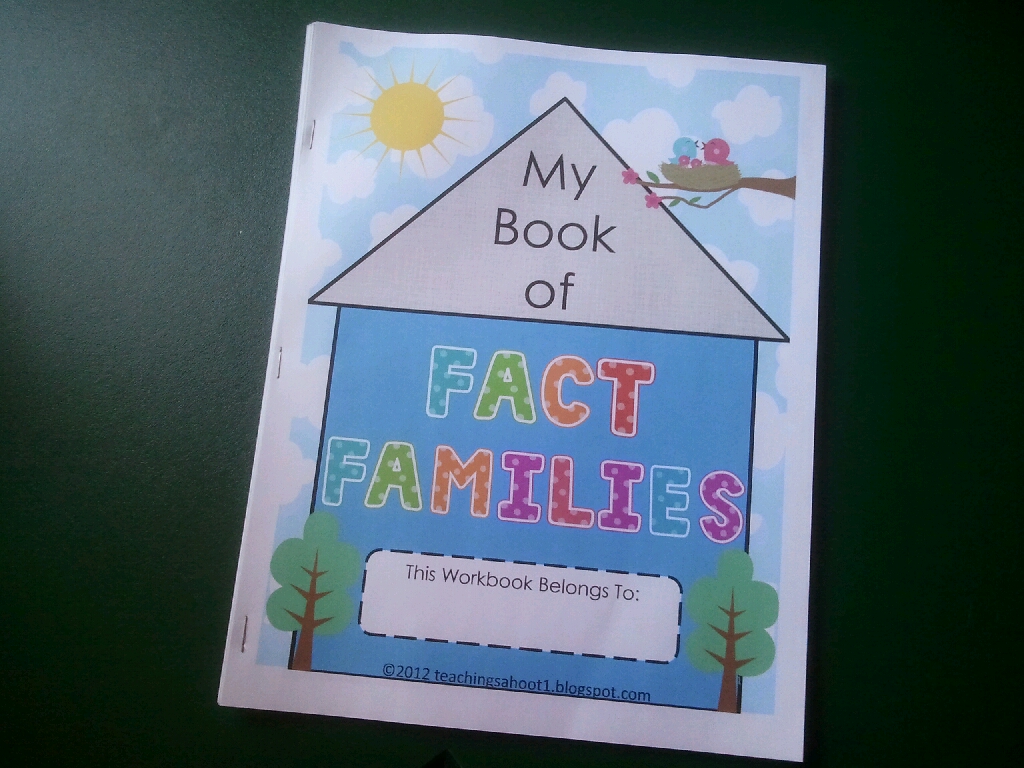
There were so many of Nicole's items that aligned with my first grade curriculum in MA (life cycles, living/nonliving, etc.), but I chose to review her item entitled "My Book of Fact Families."  You see, that was what I was just starting to teach.  I've seen adorable ideas out there with the "fact family in a house" theme, but never came across any first-hand.  This item was exactly what I needed.  It includes over 60 (yes, 60) pages of all the possible fact families for numbers 1-10.  There's a colorful cover too.  Each page has a house with a cloud backdrop and is decorated with charming clipart.

Here's how I used Nicole's "My Book of Fact Families" in my classroom.  I printed, in color, and laminated a bunch of her sheets.  I love laminating...woohoo. 

 
Next, I got a shiny new clipboard and tied a bunch of colored curling ribbon to the top (spring has hit New England).  I was a bit cheerful.  I also attached a dry-erase marker.  


In my math center I let children fill out the members of the fact family and show me when they were done.  Then, they easily erased their answers and got another sheet.


I also decided to print out the cover page, in color.  I printed the other pages in black and white ink and decided to make a book with most of the pages for all of my first graders, because they were really into this activity.  How neat is this cover?


In my math center, I made our number lines, 120 grids and 10-frames with colored counters readily available to complete the fact families if needed.  My two furbabies are standing quite proud by the final product.  They both give it two paws up!  Oh, I also used some sheets for Before School Work and for homework--so many uses...


There you have it!  "My Book of Fact Families" is a valuable addition to my unit of addition--obviously it's Common Core-aligned and ready-to-go.  To get this item, please click away HERE.  Click HERE to check out  some more quality resources out there in the blogging world.  This swap is always so much fun.  It's great to meet other teachers from all over the country and to have a chance to grab and try out a great product.


Raise That Reading Stamina!

What is stamina and how does it apply to reading you may ask?  I found this anchor chart on Pinterest that's a good start.


I've been reading a lot of the importance of building reading stamina in our young readers for quite some time.  My interest in this topic stemmed from a discussion of a monthly data leadership team meeting in my school.  We were talking about reasons why our students were not getting certain items correct on our practice standardized tests when we knew they "knew" the answers.  My colleagues felt as if the students grew tired as the practice test went on, were not giving their all or as if they simply gave up. 

As a first grade teacher, and literacy instructor, I wondered what can we do to "boost their performance."  My response was that we need to build our students' stamina.  I feel too often students are reading in guided reading groups or with buddies.  There's not enough time built into the day for our young readers to read books at their independent reading level for an extended period of time.  The importance of this time is necessary to build a community of strong readers which is essentially our goal as teachers--not to raise standardized test scores.  

Independent reading to me means a lot more that just having my students read quietly to themselves.  This block of times starts with a minilesson or link to a previous reading lesson.  For this, I remind students what particular reading strategy we have been learning.  I let them know that they have watched me model the strategy, have helped me with the strategy whole class and have done the strategy in small guided reading groups with my help.  It's now time for them to practice using the strategy independently.  During independent reading time, I circulate and offer assistance to those students that need it.  After independent reading, we have a discussion about which strategies we used and how they helped us overcome reading obstacles.  
Everyone gets independent reading time, not just my advanced readers who finish everything early.  This time is especially important to my middle and my struggling readers too!  Research shows that way too often this population does more worksheets, computer interventions, skills in isolation, etc. when what they need is to be engaged in more reading in books at their appropriate level!  Read longer and get stronger.


Reading Rockets defines stamina as "being able to stick with something for periods if time."  This "endurance builds strength."  It offers these tips for parents which easily apply to what we need to do as teachers.

1.  Vary the way the reading is done, especially for new or struggling readers.  The three ways to do this are "read to self," "read to a buddy" or "listen to reading."  This visual (another Pinterest find) shows reading by yourself, reading to  buddy and I'm not too sure of the third icon.


2.  Make sure all books read are "just right."  A child should be able to decode almost every word in an independent book correctly.  Books should interest the child and come from a variety of genres.

3.  Set reasonable reading goals.  For toddlers and preschoolers, it's difficult for them to sit for a long time, regardless of how engaging the book may be.  Start with just a few minutes and then build up from there.  Elementary-aged readers should start with 10-15 minutes.  A few minutes can be added every few weeks or so.

4.  Take time to celebrate and chart progress.  Make a graph.  Talk about the books, recommend a book to a buddy, go to the library to get more books, etc.


In the older grades, reading stamina is essential in order to navigate through longer text of various forms.  It's never too soon to start to build it!  Built from the inspiration in the visuals, I came up with a few posters to use with my students.  You can get your copy as part of Manic Monday's Classroom Freebies.


Classroom Freebies Manic Monday

A Bunny Blog Hop

A Tisket, A Tasket, Freebies for your Basket!

Several phenomenal teachers and bloggers are joining forces for an amazing bunny blog hop!  As you follow us along the bunny trail, you will visit some of your favorite blogs and discover a few new blogs too!  Each with a fabulous freebie just for you!


Thank you for hopping on over to my blog! 

Recently, I completed a second post featuring my Classroom Makeover Series  complete with my "All in One Word Wall" bundle (scroll down below).  I gave my Word Wall a heavy duty makeover.  For my Funny Bunny Freebie, I knew I had to create some "Use-Them-Anytime" activities to share with you all.  They are perfect for grades kindergarten to grade three.

The first part has five sheets that can be copied and placed in a literacy center.  The second part has six additional activities you can print out ahead of time and use them for Word Work in your literacy block.  Check out this Scavenger Hunt.


Working on Alphabetical Order?  This activity can be used over and over again.


These activities include rhyming, digraphs, writing sentences, vowel teams, using question words, and syllabication--OH MY!

 So here they are...

Enjoy my "What Do I Do With My Word Wall?" Freebie by clicking HERE!


Thanks for stopping by and visiting!  If you are new to my blog and liked what you see, don't forget to follow me.  A Tisket, A Tasket, next up with a Freebie for your Basket is Susanna from Whimsy Workshop.  Hop on over!


Just in case you didn't join us from the beginning, here is an ordered list of all the participating blogs.

Stephany from Primary Possibilities
Sally from Elementary Matters
Lory from Fun for First
Linda from Primary Inspiration
Nicole from Mrs. Rios Teaches Second Grade
Brian from Hopkins' Hoppin' Happenings
Liz from The Happy Teacher
Jennie from JD's Rockin' Readers
Sarah from Learning is for Superstars
Teresa from Fun in K/1
Nikki from Teaching in Progress
Faith from Kindergarten Faith
Renee from Fantastic First Grade Froggies
Amy from Happy Teacher Heaven
Leah from Learn with Leah
Nicole from Teaching's a Hoot
Kristy from The Phonic's Phenomenon
Rich from Mr. Giso's Room to Read
Susanna from Whimsy Workshop
Amy from Motivate to Learn
Lola from Preschool Wonders
Kimberli from Mixing the Next Batch


A Hippity Hoppity Spring Time Craft

So, due to lots of snow days, one hurricane day, 100th Day and Valentine's Day (on the SAME day), my traditional winter craft simply did not get done this year.  I usually use three recycled cans to make adorable snowmen and snowwomen wind chimes with the kids.  Come March, I still had loads of cans taking up my back table.  So, a new craft was born--spring bunnies.  We do have snow on the ground, but I thought this idea would be more appropriate.  We recently read an informational text article in a big book on cottontails during a finding the main idea mini-lesson, so it was perfect!  They came out really adorable, so I wanted to share.

First, I gathered three cans (of different sizes) for each student.

Second, my firsties sponge-painted all three cans (outside only) using either a white or a pink acrylic paint.  It has to be acrylic or it will flake off!  They dab, not rub the paint...


Third, we took the smallest can and added two eyes, two ears (cut from foam board), a pink pompom for the nose and two white pompoms for the mouth part.  I used hot glue.  The kids were in charge of passing me the add-ons.   Of course, the paint dried first. It took a day, overnight.


Fourth, I got a nail and hammered it through each can in order to make a hole in the can's center.


Fifth, we used a heavy twine and strung the cans together.  At the bottom we tied a wooden bead so the string would stay.  At the top, we made a loop to hang the wind chimes.


Check out our recycled can, bunny farm.  These are some bunnies!


Diary of My Word Wall Makeover

This is my second blog post in my "Classroom Makeover Series."  After making significant improvements in my Mathematics Center for my first "Classroom Makeover," I had easily decided to go on to making over my supply cart.  One afternoon, however, I came across an old blog post (2011) on Word Walls inspired by the great Debbie Diller.  In Chalk Talk: A Kindergarten Blog, Mrs. Larremore sports her word wall with insightful recommendations based on Debbie Diller's Work.  Having incorporated this great blog find with some research of my own, my goals for this makeover included the following.

               1.  Improve the Location:  My prior word wall was located pretty far away from my four groups of students' desks.  In addition, I even had a rolling chart stand, an easel and some other furniture blocking parts of the word wall.  I know what you are thinking.  This is a big "no, no."

               2.  Make the Words Uniform:  My prior word wall words (purchased from a teacher store that shall remain nameless), were in many different colors with the words all trimmed according to the shapes of the letters.  This did not appear to be uniform, and was in fact a bit distracting to the eye.

               3.  Add a Picture to Reinforce Letter Sounds:  My prior word wall obviously had both upper and lower case letters, but did not have a picture to reinforce initial sounds.  I teach first grade, and not all of my young readers arrive knowing all of their letter sounds.  Since I add words to my word wall starting the first full week of school, having pictures along with my letter headings would be more effective to ALL learners from day one.

               4.  Increase the Space and Create an Organized Grid for My Word Wall:  The organization of my prior word wall was not balanced, visually.  It was measured according to how much space I needed for each letter.  For example, I had a large space for "W" because I knew I would have a lot of "w" words to put up.   This was due to a limited space on my bulletin board.  By creating a grid with electric tape and by moving my word wall to where there's more space, I knew it would be easier for my kids to use.

               5.  Utilize a Solid Background:  My words on my prior word wall were placed on a busy fabric.  This was definitely too distracting for my first graders.  

SO, with these goals in mind, I'm almost embarrassed to show these two before pictures of my word wall.  If you look closely, you will see it in the distance. 


Note that the ribbon border above was added right after I came across the blog by Chalk Talk.  I was so amazed at the difference it made, I kept on going with the improvements.  The brain definitely sees better with borders.  

First, I removed all the store bought visuals from my cabinets.  I couldn't remember the last time my students used many of them.  Second, I purchased a bunch of this electrical tape and started measuring with my tape measure.


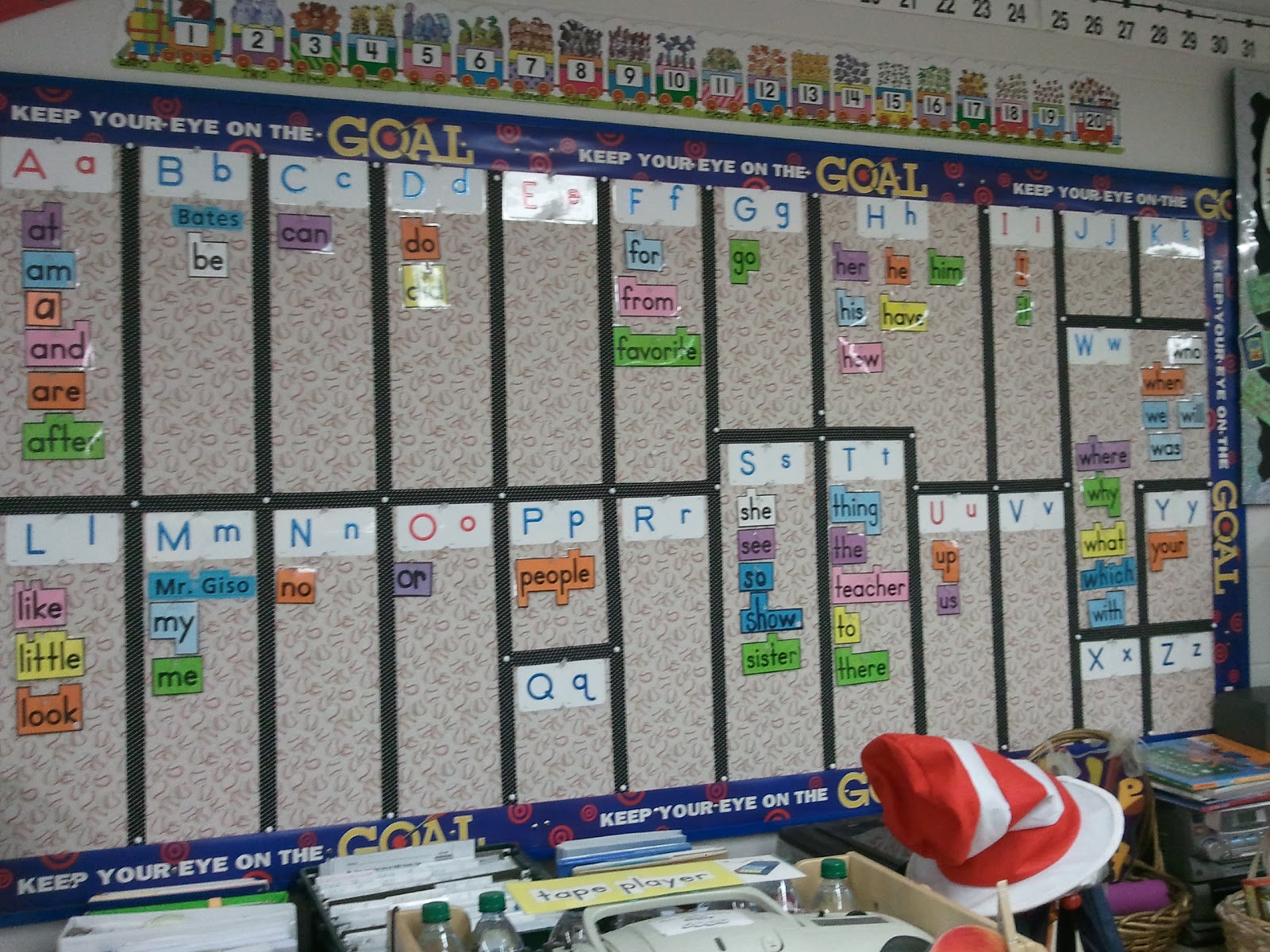
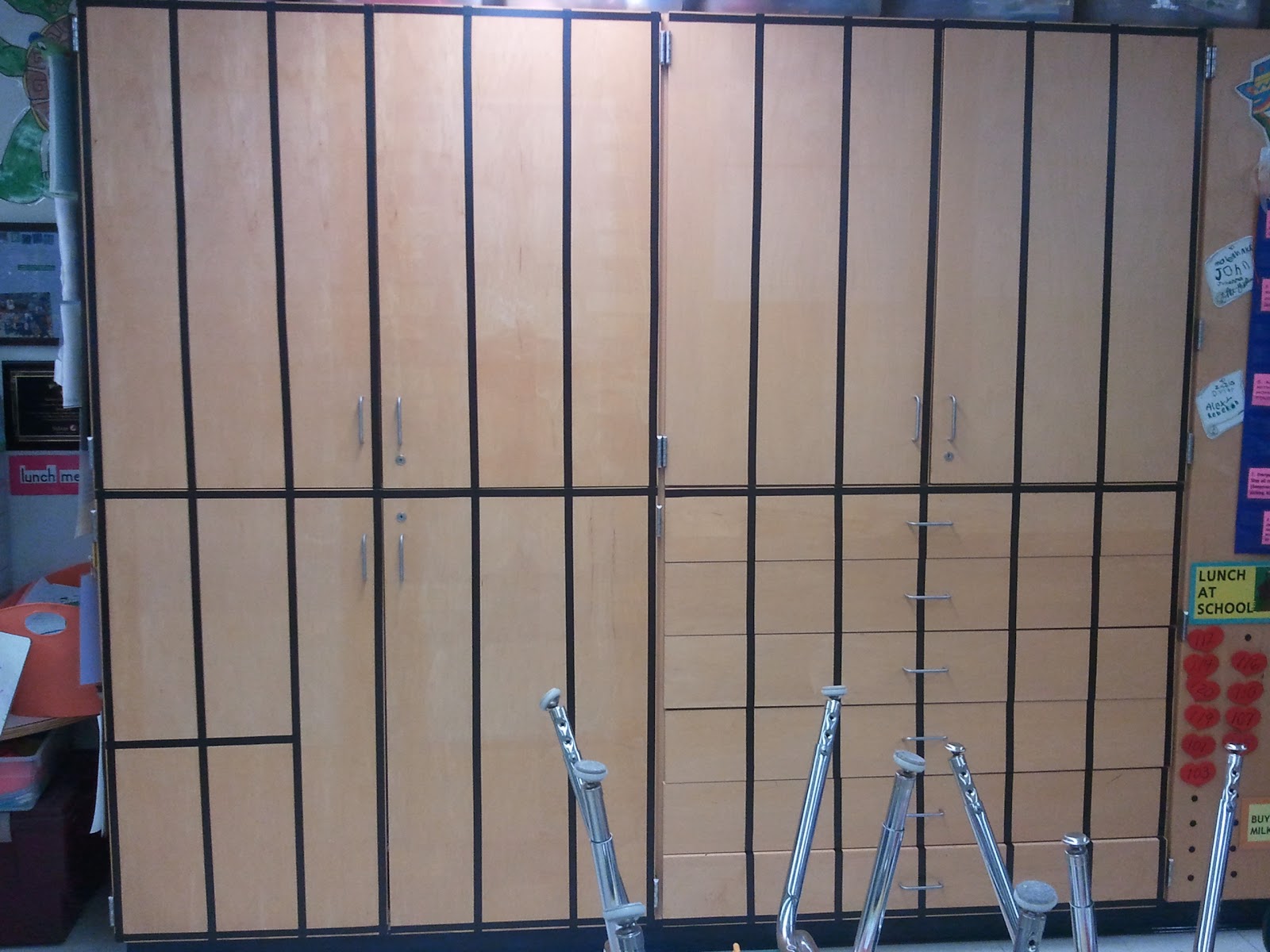
I decided to make a 2 by 12 grid in order to create 24 boxes for 24 letters of the alphabet.  I added the last two letters, Y and Z, at the bottom.  It looks a little bit like jail, I know, but boy does it look organized!   


Third, I went to work searching for the perfect font, frames and clip art to make my my letter headings and word wall words.  I trimmed, cut and laminated away.  Lots of words, words, words!  I colored the whole word yellow when it began with a vowel for easier recognition.


After this, my fourth and final part of this makeover was the most exciting.   I put up the letter headers and the words we had added so far.  Right away, you can notice the difference.  I decided to incorporate the headline, midline and baseline into each word to encourage my first graders to not only correctly spell, but to also correctly write each word with accurate letter formation.


Look how nicely the vowel "O" and its words stand out in yellow.


It was quite the project doing the tape work around my pull out drawers.  I even cut the letter headings, too and removed some hardware...shhhhhh.  Notice how the columns made with the electrical tape draw your eyes to each letter and its words so easily!  It's amazing how our brains work.


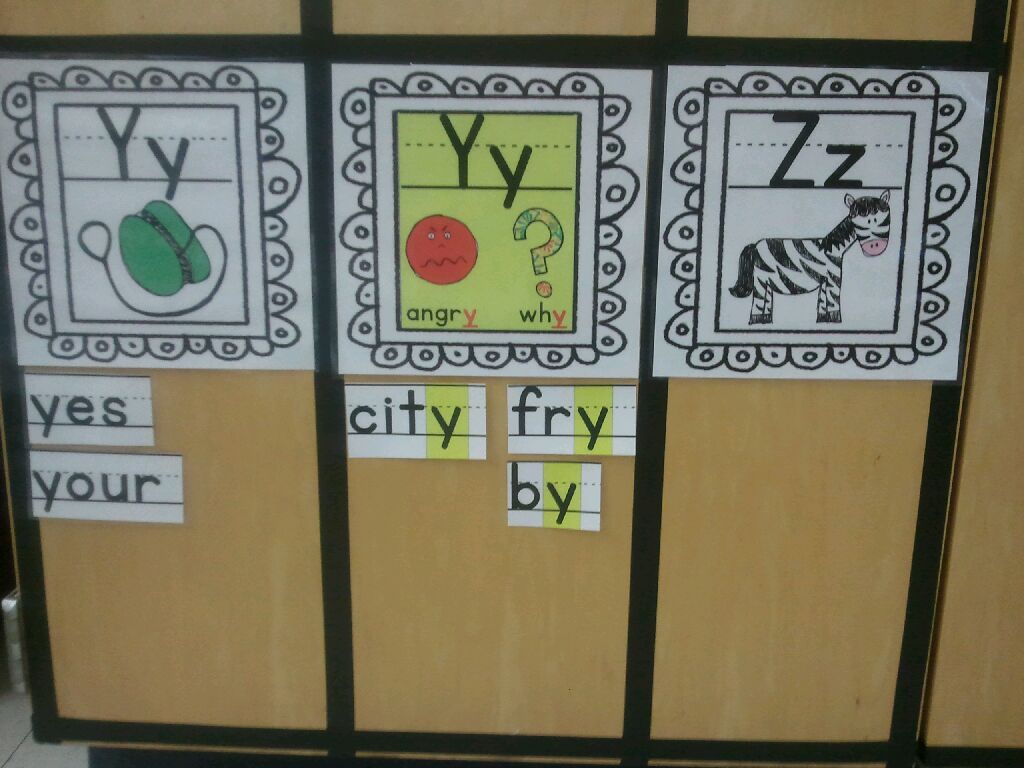
I decided to add a section for "Y" when it is used as a vowel.  Too often we just say "sometimes y" when we chant the vowels, but my new word wall offers a visual to reinforce the fact that "Y" serves as a vowel when it sounds like long "e" or long "i."  Check this out.


Last but not least, my finished product was ready.  My new Word Wall is right next to my students' desk groups and is most definitely easy to read.


To get the colorful letter headers, a "Word Wall" banner (not pictured) and the words included in the pre-primer to third grade Dolch List (plus more bonus words that I use), head on over to my TpT store by clicking here.  

Some Word Wall Suggestions for You to Consider

How does your word wall measure up?  You may want to consider the following.

•Do you have BOTH upper and lower case letters displayed in alphabetical order?

•Do you have your VOWELS in a distinct color in order for them to stand out from the consonants?

•Do you (for Pre-K and K) have examples of environmental print up such as cereal names, fast food names, road signs, candy bars, etc.?

•Do you for (Pre-K and K) have the student names on the word wall to help them learn the sounds?

•Do you have appropriate high frequency words displayed in which you hold students accountable for BOTH reading and spelling them?

•Do you have your word wall displayed in your whole-class teaching area for easy visibility?

•Do you have your word wall low enough (for the younger grades)?

•Do you have an interactive component to your word wall (can students take the words off easily with magnets, Velcro etc.)?

•Do you have a grid with borders for each letter and its words?  Remember our brains are programed to "see in borders!"

•Do you have the words large enough, in black, and on a solid background without patterns or loud borders?

•Do you have interesting vocabulary words in addition to high frequency words in grades two and up?

•Do you (for grades Pre-K to grade one) feature a picture to accompany each letter to foster phonics?

•Do you have tools for word work nearby (pointers, wands, magnetic letters, letter tiles, etc.)?

I hope I've inspired you to make your word wall more student friendly.  Let me know what you think.


What's Mr. Giso Making "Room to Read" Pick #7

Mirror Mirror
By:  Marilyn Singer
Illustrated by:  Josee Masse


I've had this brilliant book standing upright on my desk at school for the longest time, just waiting to share it.  Being Daylight Savings time and all, means I enjoyed an extra hour of sunlight today.  As a result, I'm feeling extra productive, so here it goes!

Mirror Mirror a Book of Reversible Verse is just one of over 80 books for children by Marilyn Singer.  Singer entertains the age old saying that there is more than one side of a story.  The topic of each page is a familiar fairy tale.  Each poem is paralleled in what Singer refers to as her "reverso."  Simply put, a reverso is a poem read from the bottom up using meaning altering punctuation and capitalization.  This puzzled verse is the perfect style for letting the reader know the two points of view each fairy tale has to offer. It has definitely given this reader a new perspective.  

In this "reverso" of Little Red Riding Hood, we are presented with a poem on the left in which Little Red Riding Hood is telling us her story of "picking berries to eat-."  She "mustn't dawdle," as her Grandma is at home waiting.  On the right, you find the reverso. 
The Big Bad Wolf spies Little Red Riding Hood trespassing in his "hood."  She is his "juicy and sweet" treat "picking berries to eat."


What's perfect about this book is that both poems are presented on each page.  You don't literally have to read the poem from the bottom up to get the double meaning--it's done for you.  The illustrations by native Canadian Masse offer the perfect visual for the reader.  Just as each poem is split in half, so are her illustrations.  We get both points of view in her vibrant, bold and fairly tale-like paintings.  For adult readers, her artwork brings back the fondest memories of childhood.

Some of the classic fairy tales covered in this book include Cinderella, Rapunzel, The Ugly Duckling, Snow White, Jack and the Beanstalk and  Hansel and Gretel.  Both the poems and the illustrations work hand in hand to inspire children to step back and realize that perhaps the Three Bears were just as scared as Goldilocks, and that maybe the Prince could have used a few hours of the sleep that his Sleeping Beauty took for granted!

I can see middle or high school English teachers using this book with their students accompanying a lesson on writing original "reverso" poems.  Obviously, it's a great read aloud for children of all ages and a great gift for a child to add to his or her bedtime book collection.  Scroll down to my book picks to order it.